

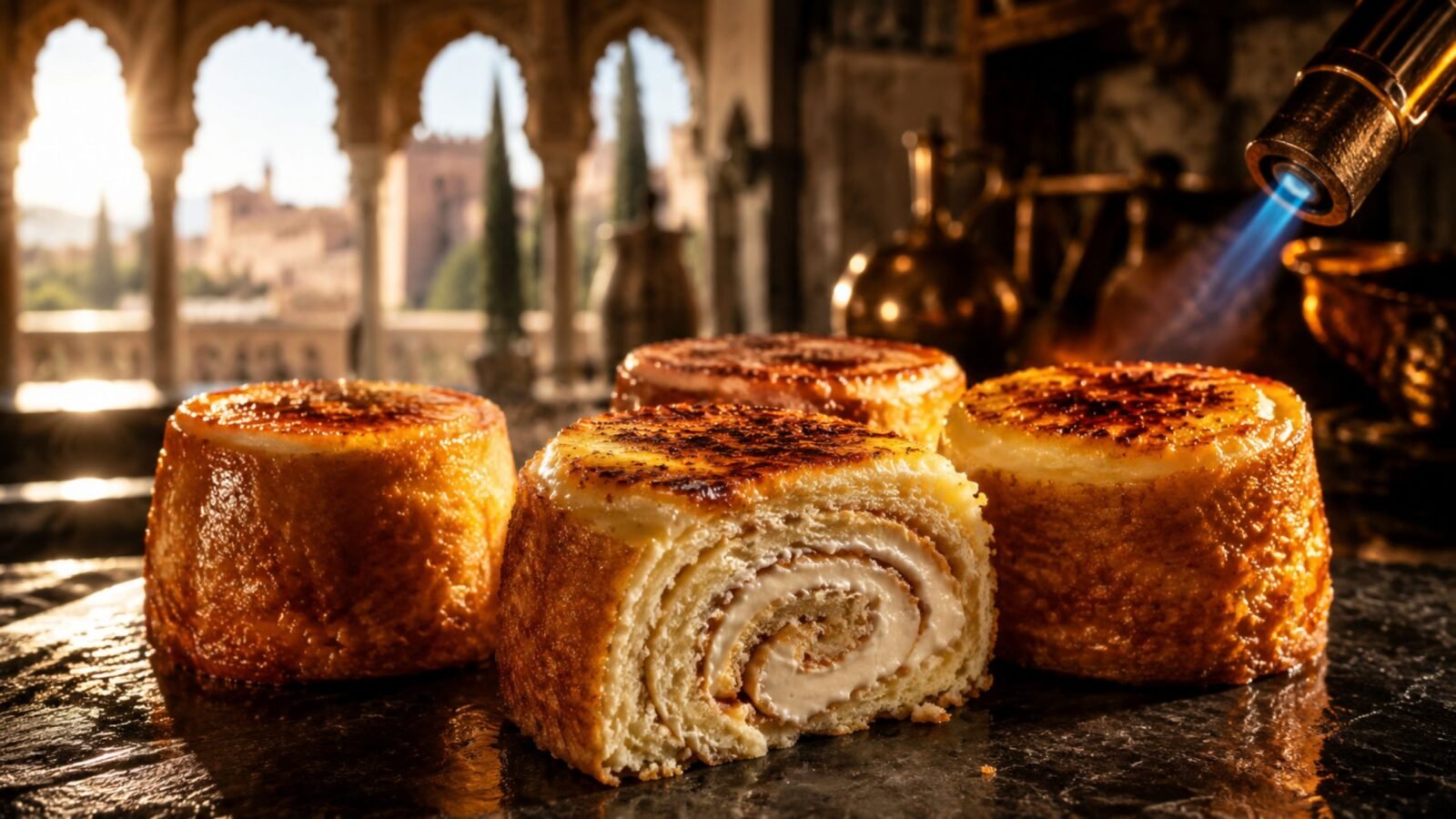
The nearest bakery may satisfy the craving, but Santa Fe’s finest pionono is defined by freshness, syrup balance and a properly torched crown—not proximity alone.
A search for the best piononos de Santa Fe near me usually begins with a simple craving: a small spiral of syrup-soaked sponge, cinnamon-scented cream and caramelised topping. Yet the search results can quickly become confusing because “pionono” describes markedly different foods across Spain, Latin America, the Caribbean and the Philippines.
The Spanish original belongs specifically to Santa Fe, a municipality beside Granada in Andalucía. It is not a large Swiss roll, a dulce de leche roulade or a savoury plantain cup. A proper Pionono de Santa Fe is a compact, upright pastry designed to be eaten in one or two bites.
Location also changes the answer. In Santa Fe, the historic Casa Ysla remains the provenance-led choice. In central Granada, several established pastry houses provide more convenient alternatives. Outside Andalucía, authenticity must be judged by structure, ingredients, freshness and handling rather than by the word “pionono” on a menu.
The best Pionono de Santa Fe is a freshly made, syrup-moistened sponge roll filled with cream and cinnamon, stood upright and finished with a torched cream crown. For historical provenance, Casa Ysla in Santa Fe is the strongest choice; in Granada, Mercedes Isla and Rey Fernando are credible alternatives.
The Three Addresses That Deserve Your Attention First
There is no independent, universally accepted ranking of Granada’s piononos. The recommendations below are therefore based on documented provenance, established production history, official location information and fidelity to the recognised Santa Fe format—not an invented scoring system.
| Pastry shop | Best suited to | Verified location examples | Why it stands out |
|---|---|---|---|
| Casa Ysla | The historic reference point | Calle Real 10, Santa Fe; A92G Km 3.3, Santa Fe; multiple Granada branches | Founded by the family associated with the modern Santa Fe pionono |
| Mercedes Isla | Artisan-style alternatives and gluten-free enquiries | Granada | Publicly states that it follows the traditional recipe and artisanal method |
| Rey Fernando | Central Granada convenience and extended opening hours | Reyes Católicos 28, Granada; Real 31, Santa Fe | Producing pastries since 1945, with shops in both Granada and Santa Fe |
Casa Ysla: The Provenance-First Answer
When “best” means closest to the documented source, Casa Ysla is the clearest recommendation.
The company traces its pionono history to 1897, when Ceferino Isla González opened a pastry workshop on Calle Real in Santa Fe. Casa Ysla states that he created the pastry as a tribute to Pope Pius IX—Pío Nono in Italian—and shaped it to evoke the pontiff’s cylindrical robes and skullcap.
Its two most relevant Santa Fe locations are:
- Calle Real 10, 18320 Santa Fe
- Carretera Santa Fe–Granada, A92G Km 3.3, 18320 Santa Fe
Casa Ysla also lists numerous branches around Granada, including Plaza Bib-Rambla, Reyes Católicos, Acera del Darro, Carrera de la Virgen and Avenida de la Constitución. Travellers can check the current Casa Ysla establishment directory before visiting.
The larger A92G premises is particularly useful for visitors travelling by car between Granada and Santa Fe. The Calle Real branch offers the stronger geographical connection to the pastry’s birthplace.
Mercedes Isla: A Serious Option for Dietary Enquiries
Mercedes Isla presents itself as a Granada pastry house that respects the traditional recipe dating from 1897 and continues to make piononos artisanally.
It is also notable for its work on gluten-free pastries. The Granada celiac association has documented Mercedes Isla’s development of gluten-free piononos and broader gluten-free bakery production. That does not eliminate the need for individual checks: customers with coeliac disease or severe allergies should confirm current ingredients, production areas and cross-contact controls directly with the shop.
Choose Mercedes Isla when dietary accessibility matters as much as historical style.
Rey Fernando: The Practical City-Centre Choice
Rey Fernando states that it has produced artisanal pastries since 1945 from a workshop in Santa Fe. Its official site lists shops at Reyes Católicos 28 in Granada and Real 31 beside Plaza de España in Santa Fe.
The company’s site currently lists store hours from 8:00 a.m. to midnight, Monday through Sunday. Hours can change during holidays, local festivals or seasonal periods, so same-day confirmation remains advisable.
Rey Fernando is particularly convenient for travellers staying near Granada Cathedral, Plaza Nueva or the lower Albaicín who do not plan to travel separately to Santa Fe.
What a Real Pionono de Santa Fe Should Look and Taste Like
The original format is small but technically demanding. Its quality depends less on elaborate decoration than on control of moisture, texture and caramelisation.
A recognisable Santa Fe pionono normally contains:
- A thin sheet of soft sponge cake
- Sugar syrup that moistens without saturating the sponge
- A fine internal layer of cream
- Cinnamon or gently spiced aromatic notes
- An upright cylindrical shape
- A cream crown dusted with sugar and torched
Casa Ysla describes the pastry’s shape as an intentional representation of Pope Pius IX: the rolled sponge forms the body, while the toasted cream crown represents the papal skullcap.
A 2025 report by El País documented the modern production process at Casa Ysla. Sponge is cut into strips, treated with syrup, cream and cinnamon, rolled, positioned vertically and finished with additional cream and a flame-caramelised top.
The Five-Second Quality Test
Before ordering a box, inspect one pastry closely.
| Quality signal | What you should notice | Warning sign |
|---|---|---|
| Sponge | Supple and moist | Dry edges or a rubbery roll |
| Syrup | Even moisture throughout | Liquid pooling in the paper cup |
| Cream | Smooth, restrained and integrated | Thick icing that overwhelms the sponge |
| Cinnamon | Warm background aroma | Harsh or powdery aftertaste |
| Caramelised crown | Thin, freshly torched surface | Pale, wet or heavily burnt topping |
The best examples hold their shape when lifted but yield immediately when bitten. They should taste sweet without becoming merely sugary.
Editorial verdict: Start with the traditional version before ordering flavoured adaptations. The original reveals whether the bakery understands sponge hydration, restrained filling and precise caramelisation; novelty flavours can conceal weak pastry technique.
Why Santa Fe Became the Pastry’s Permanent Home
Santa Fe lies immediately west of Granada and is historically associated with the Capitulations of Santa Fe, signed between Christopher Columbus and the Catholic Monarchs in 1492. Its culinary identity, however, is now strongly tied to the pionono. Granada’s official tourism organisation describes the pastry alone as sufficient reason to visit the municipality.
The modern pastry is generally credited to Ceferino Isla and his 1897 workshop, although food history can be less tidy than commercial origin stories. Earlier Spanish references to similarly named sweets exist, while the use of syrup, cinnamon and enriched sponge reflects deeper Andalusian confectionery traditions.
What Ceferino Isla appears to have established was the specific Santa Fe form: a small upright spiral with a torched cream crown and a visual connection to Pius IX.
The pastry subsequently spread from Santa Fe into Granada’s cafés, bakeries and restaurants. By 2025, Casa Ysla was reportedly producing around 50,000 units per week, while Obrador Robles was producing approximately 12,000. Traditional piononos were also being offered by Mercedes Isla, Rey Fernando and other Granada pastry businesses.
“Near Me” Depends on Which Side of Granada You Are Standing
When You Are Already in Santa Fe
Go directly to Calle Real for the strongest origin experience. Casa Ysla at Calle Real 10 and Rey Fernando at Real 31 are close enough to compare without turning the tasting into a full-day expedition. Official addresses should still be checked before departure.
When You Are Staying in Central Granada
A dedicated journey to Santa Fe is not essential. Casa Ysla operates several branches in central and greater Granada, including:
- Plaza Bib-Rambla 22
- Reyes Católicos 57
- Carrera de la Virgen 27
- Acera del Darro 62
- Avenida de la Constitución 3
- Méndez Núñez 4
These locations make an authentic-style pionono accessible from the cathedral district, shopping centre and main railway-station corridor. (Pionono)
When You Are Driving Through Andalucía
Casa Ysla’s A92G premises near Santa Fe is the practical stop. The building combines direct road access with proximity to the company’s production base. El País identifies this roadside Santa Fe operation as the best-known surviving pionono workshop in the municipality.
When You Are Outside Spain
Search results require more scrutiny because the same name can describe several unrelated dishes.
Use search combinations such as:
- “Pionono de Santa Fe Spanish bakery”
- “Granada-style pionono”
- “Spanish pastry shop pionono”
- “Pionono crema tostada”
- “Andalusian bakery near me”
Then inspect photographs. A Spanish Pionono de Santa Fe should appear as a small upright cylinder with a toasted cream top. A large horizontal roulade filled with dulce de leche belongs to a different regional tradition, while Puerto Rican piononos are commonly savoury plantain-based preparations.
Freshness Matters More Than an Extra Five Minutes of Driving
Piononos are moisture-sensitive pastries. Their defining contrast—soft sponge, absorbed syrup, smooth cream and a lightly torched surface—deteriorates when they are stored poorly or held too long.
For the best result:
- Buy from a shop with visible turnover. Frequent replenishment is preferable to an elaborate display of pastries that may have been sitting for hours.
- Ask when the batch was made. “Made today” is more useful information than a vague claim of authenticity.
- Keep the box level. The pastries stand vertically and can collapse against one another during transport.
- Follow the bakery’s refrigeration instructions. Cream-based pastries require appropriate temperature control.
- Allow chilled pastries a brief tempering period only when the producer recommends it. Excessive warmth can destabilise the cream and syrup.
- Eat them promptly. A pionono is not designed as a long-life packaged cake.
Do not leave a cream-filled box inside a parked vehicle, particularly during Granada’s hot summer months.
Ordering Without Guesswork
Before travelling, verify four details:
- Whether traditional piononos are available that day
- Whether individual pieces and boxed quantities are both sold
- Whether advance ordering is recommended
- Whether the shop can accommodate gluten, dairy, egg or nut restrictions
Traditional ingredients commonly include wheat, egg, sugar and cream or other dairy components. Recipes and production environments differ, so an ingredient list from one bakery cannot be applied automatically to another.
Price also varies by shop, quantity, packaging and delivery method. Because menus and promotional boxes change, a current first-party price is more reliable than an old blog post or user-uploaded photograph.
Frequently Asked Questions
Where can I find the best Piononos de Santa Fe near me?
The best historical choice is Casa Ysla in Santa Fe, particularly its Calle Real or A92G locations. Travellers in Granada can use Casa Ysla’s city branches or compare established alternatives such as Mercedes Isla and Rey Fernando. Search by exact bakery name rather than relying only on generic “pionono near me” results.
What is a Pionono de Santa Fe?
A Pionono de Santa Fe is a small Andalusian pastry made from rolled sponge cake moistened with syrup, layered with cream and cinnamon, placed upright and crowned with caramelised cream. Its modern form is associated with Santa Fe in Granada Province and the pastry chef Ceferino Isla.
Is Casa Ysla the original pionono bakery?
Casa Ysla is the bakery most directly associated with the modern Pionono de Santa Fe. The company dates its history to 1897, when Ceferino Isla González opened his Santa Fe workshop and developed the pastry as a tribute to Pope Pius IX.
Can I buy authentic piononos in Granada without visiting Santa Fe?
Yes. Casa Ysla lists multiple branches throughout Granada, including central locations at Plaza Bib-Rambla, Reyes Católicos and Carrera de la Virgen. Rey Fernando also operates in central Granada, while other established pastry houses produce their own versions.
Are Piononos de Santa Fe gluten-free?
Traditional piononos are generally made with wheat-based sponge and should not be assumed gluten-free. Mercedes Isla has been publicly associated with gluten-free pionono production, but customers with coeliac disease must verify current ingredients, segregation procedures and cross-contact precautions directly with the bakery.
What is the difference between a Spanish pionono and a Latin American pionono?
A Spanish Pionono de Santa Fe is a small upright pastry filled with cream and topped with caramelised cream. In several Latin American countries, “pionono” usually refers to a larger rolled sponge filled with dulce de leche, fruit or savoury ingredients. In Puerto Rico, the name commonly refers to plantain-based savoury preparations.
The Best Search Ends Where the Pastry Began
For the most defensible answer to best piononos de Santa Fe near me, begin with provenance.
Casa Ysla is the reference choice because its family history is inseparable from the modern pastry’s documented identity. Mercedes Isla merits attention for artisan production and gluten-free enquiries. Rey Fernando offers a convenient comparison in both Santa Fe and Granada.
Still, reputation cannot rescue a badly stored pastry. The decisive pionono is the one served fresh: sponge fully moistened but intact, cream present without excess, cinnamon controlled and the crown caramelised moments before sweetness turns to bitterness.
That balance—not the size of the box, the novelty of the flavour or the number of search-engine stars—is what makes the journey worthwhile.
Sources and Verification
- Official Andalucía Tourism: Piononos de Santa Fe — Regional tourism reference for the pastry’s connection to Andalucía and Granada.
- Casa Ysla company history and account of Ceferino Isla’s 1897 workshop.
- Casa Ysla official establishment directory, consulted for current listed branches and addresses.
- Rey Fernando official website and company history, consulted for locations, stated opening hours and production history.
- El País, April 17, 2025, consulted for documented production methods, output figures and the contemporary Granada pastry trade.
- Granada celiac association, consulted regarding gluten-free pionono production associated with Mercedes Isla.
Editorial Disclaimer: Business addresses, operating hours, menus, prices, recipes and allergen procedures can change. Recommendations reflect publicly available evidence rather than anonymous ratings or paid placement. Readers should verify current opening information, product availability and dietary suitability directly with each bakery before travelling or ordering.